Shahzia Sikander Turns Hong Kong's Waterfront Screen Into a Map of Empire and Extraction
On the M+ Facade in Hong Kong, Shahzia Sikander's new animation 3 to 12 Nautical Miles uses maritime law, colonial trade, and cartography to recast the city as a site where sovereignty is still being negotiated.
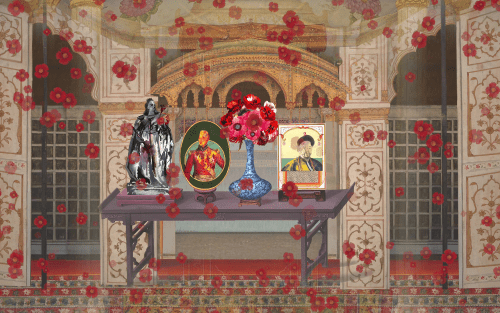
Shahzia Sikander's new work 3 to 12 Nautical Miles, now playing on Hong Kong's M+ Facade, takes a technical phrase from maritime law and turns it into a thesis about empire. The Art Newspaper describes the work as an animated meditation on sovereignty, surveillance, and access, built around the historical expansion of territorial waters from three nautical miles to twelve. In Sikander's hands, that shift becomes more than a legal footnote. It becomes a way of visualising how states claim, extend, and aestheticise power.
The commission matters because of where it is staged. As a public project tied to M+'s presentation page for the work, it is framed not as visual wallpaper but as a sustained historical argument. The M+ Facade sits on Hong Kong's waterfront, a literal threshold between land and sea, trade and culture, spectacle and infrastructure. Sikander told The Art Newspaper that the site is not incidental but central to the work's meaning. Hong Kong appears not as a neutral screen for global art branding but as a territory shaped by the legacies of extraction, shipping routes, colonial administration, and contested jurisdiction. In other words, the work uses the city's skyline as both support and subject.
Sikander's own account of the piece, published by Art Basel Hong Kong, makes the historical architecture explicit. She links the decline of Qing authority, the weakening of Mughal sovereignty, and the rise of the British East India Company as interconnected developments rather than separate regional stories. The animation moves through poppies, ships, maps, thrones, and female figures that shift in identity as they move across the frame. These are not decorative citations. They are components in a visual system about how domination travels, mutates, and survives under new names.
What gives the work its charge is that Sikander does not present colonial history as settled content. She presents it as something still embedded in legal structures and commercial habits. Queen Victoria appears adorned with maps as jewelry, conquest translated into ornament. Trade routes become narrative routes. Cartography functions less as description than as an instrument of possession. The logic is familiar from Sikander's broader practice, where miniature-painting traditions, Islamic and South Asian motifs, and feminist revisionism collide. But the facade scale changes the register. It takes iconography usually encountered in intimate formats and projects it across an urban surface designed for collective viewing.
This also makes the work unusually well calibrated to Hong Kong's current art ecology. The city's art infrastructure often presents itself through the language of global connectivity, efficient trade, and cultural ambition. Sikander's animation presses on the underside of that language. Connectivity, in her telling, is inseparable from the histories of coercion that made some global routes possible in the first place. That is why the work lands more sharply than a generic public-art commission might. It uses the visual grammar of grandeur to question the systems that produce grandeur.
For curators and collectors, the commission is a reminder that digital facade art does not need to collapse into event dressing. Too often large-scale screen works function as branded urban ambience, technically impressive but conceptually thin. Sikander demonstrates another option. The public screen can be a site of historical argument, especially when the artist understands scale not as enlargement alone but as a way of re-situating a debate. Here the debate concerns who gets to claim territory, narrate trade, and convert violence into law.
The work is also notable for the partnership structure behind it. It is co-commissioned by M+ and Art Basel and presented by UBS, a familiar trio within fair-week cultural production. That could easily have produced something polished and harmless. Instead, Sikander has inserted friction into the alliance. She uses a commission built for visibility and prestige to ask what kinds of extraction prestige tends to forget. That is not an anti-institutional gesture so much as a serious use of the institution's platform.
In a season crowded with fair talk about regional strength and market confidence, 3 to 12 Nautical Miles is one of the few works in Hong Kong insisting that the history beneath maritime commerce is not background material. It is the content. Sikander has made a public image for a city that still lives inside the afterimage of empire, and she has done it without surrendering complexity to spectacle.