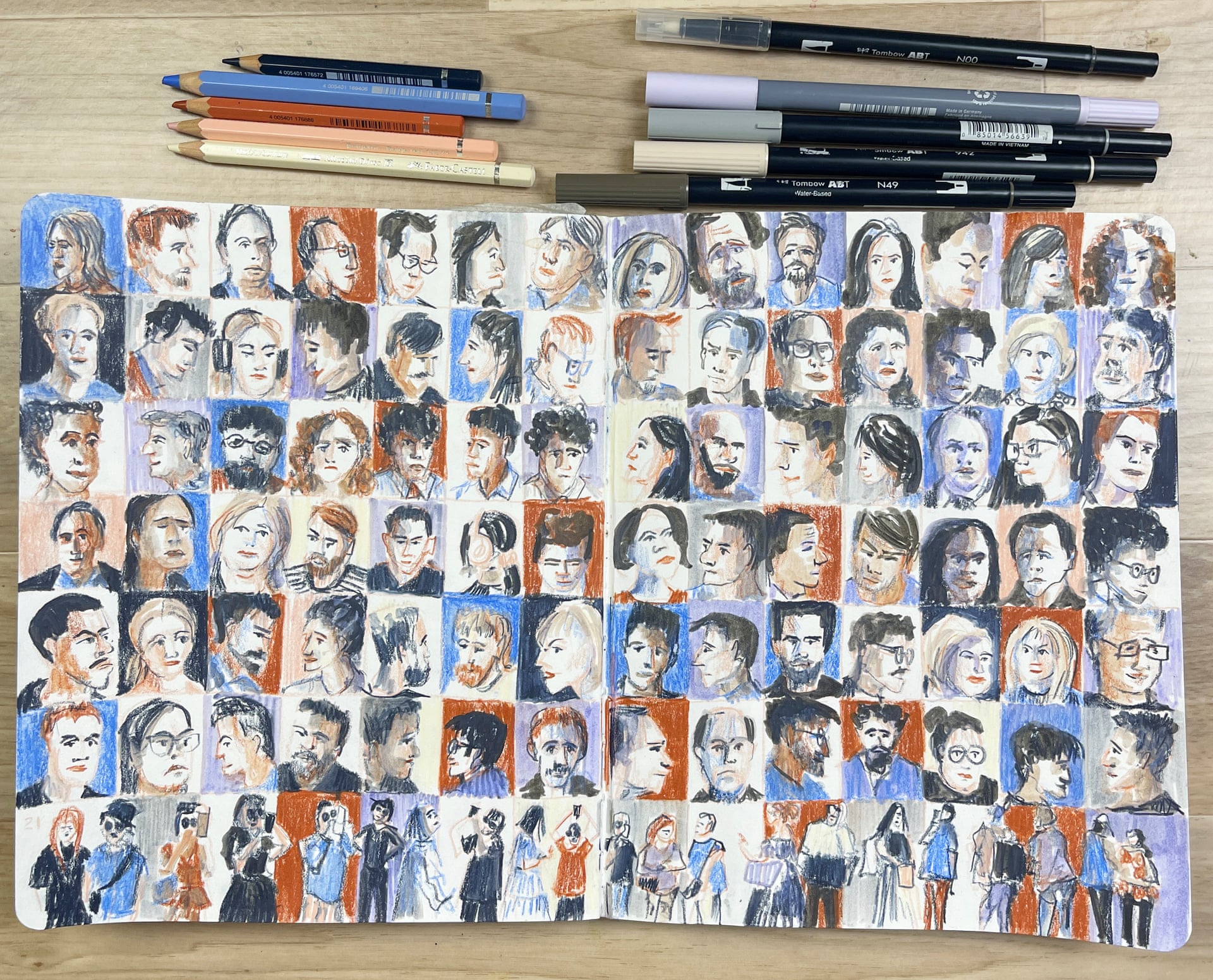
Guide: What #OneWeek100People Gets Right About Attention, Practice, and Public Drawing
The global #OneWeek100People challenge asks participants to sketch 100 people in seven days, using volume and play to reduce perfectionism and rebuild observational discipline.
If most drawing advice overemphasizes polish, #OneWeek100People does the opposite: it weaponizes volume. Sketch 100 people in seven days, and your inner editor has no time to sabotage you. The challenge is simple enough to start instantly, but deep enough to expose how you actually look at other people in shared space.
Created by Liz Steel and Marc Taro Holmes, the project has grown from a personal accountability experiment into a global, low-barrier ritual inside and beyond the Urban Sketchers ecosystem. Its durability comes from a smart premise: make the goal just difficult enough that participants must prioritize repetition over self-judgment.
This guide breaks the challenge into a practical seven-day structure for readers who want to complete it without burning out. The target remains 100, but the real objective is to build a transferable system for observational work under everyday conditions,cafes, transit, parks, waiting rooms, and wherever people naturally gather.
Before day one, set constraints. Choose one sketchbook, one black pen, and one optional color tool. Material minimalism is not aesthetic purism; it removes friction. If setup becomes complicated, consistency collapses. Steel's own practice model,tight kit, frequent sessions, low ceremony,is a useful benchmark.
Day 1 should be diagnostic, not heroic. Draw 8 to 12 quick figures from life in a location with constant turnover. Keep each sketch between 30 seconds and two minutes. You are not hunting likeness; you are mapping posture, weight, and directional energy. Expect awkward results. That is the point.
Day 2 adds sequencing. Return to similar environments and sketch in clusters of five. Track one variable only,heads, hands, or shoulder angle. Patterned repetition produces faster learning than random novelty. If possible, run one short photo-reference block at home to isolate recurring errors without social pressure.
Day 3 is where many people quit because self-critique spikes. Neutralize it by switching goals: count sessions, not quality. Three sessions of 10 sketches beats one perfectionist marathon. The challenge works because quantity disarms fear. Protect quantity at all costs.
Day 4 should include your first deliberate public-slowing exercise. Sit in one place for 25 to 40 minutes and let subjects come to you. This reverses the usual capture impulse. Instead of chasing scenes, you develop sensitivity to micro-gestures: waiting, turning, leaning, shifting weight, checking a phone, adjusting a bag strap.
Day 5 is integration day. Mix ultra-fast gesture sketches with three slightly longer studies of three to five minutes each. The short sketches preserve momentum; the longer studies convert that momentum into structure. This is usually where line confidence starts to stabilize.
Day 6 is your stress test. Draw in a less comfortable context,noisier crowd, moving train, or crowded street edge. Do not aim for polished pages. Aim for sustained attention under distraction. If attention survives, technique will follow.
Day 7 is completion and review. Finish whatever count remains, then spend 20 minutes marking your own pages: circle the strongest gestures, note repetitive distortions, and write three clear next-week goals. Without this pass, the challenge becomes event content instead of skill development.
A useful scoring model for the whole week is 40/40/20. Forty percent of your effort goes to showing up, forty percent to maintaining rhythm, and twenty percent to result quality. Most people reverse this and fail. The challenge rewards process fidelity first.
If you are teaching, #OneWeek100People adapts well to classroom settings. Assign daily minimums, then run peer annotation sessions where students identify one strength and one recurring issue per page. Pair that with references from observational pedagogy at places such as RISD and SVA for critique language that is specific but not punitive.
If you are self-directed, use lightweight digital accountability. Post daily totals, not curated highlights. This keeps the focus on practice reality and avoids the social-media trap of pretending each sketch is portfolio-ready. Public honesty tends to improve follow-through.
One reason the challenge works so well in 2026 is cultural: people are overloaded with passive image consumption but under-trained in active seeing. Drawing from life rebuilds perceptual agency. It requires decisions,where to place the figure, what to omit, how to imply movement,that scrolling never asks of you.
The method also complements photography rather than competing with it. Holmes has repeatedly framed drawing as active interpretation instead of extraction. That distinction matters for anyone trying to move from collecting impressions to building visual understanding.
For readers interested in deeper context, combine this week with resources from Drawabox, gesture practice methods from Line of Action, and archival examples of urban observation through institutions such as the V&A and the Met Museum.
Finally, do not mythologize the number. One hundred is a useful constraint, not a moral threshold. If you hit 64 with full engagement, that is still serious work. If you hit 100 while rushing mindlessly, you learned less than you think. The real metric is whether your attention changed by the end of the week.
In a culture optimized for polished outputs, #OneWeek100People is a useful corrective. It teaches that sustained attention is a skill, and skill is built by repeated contact with reality,not by waiting to feel ready, and not by mistaking polish for progress.