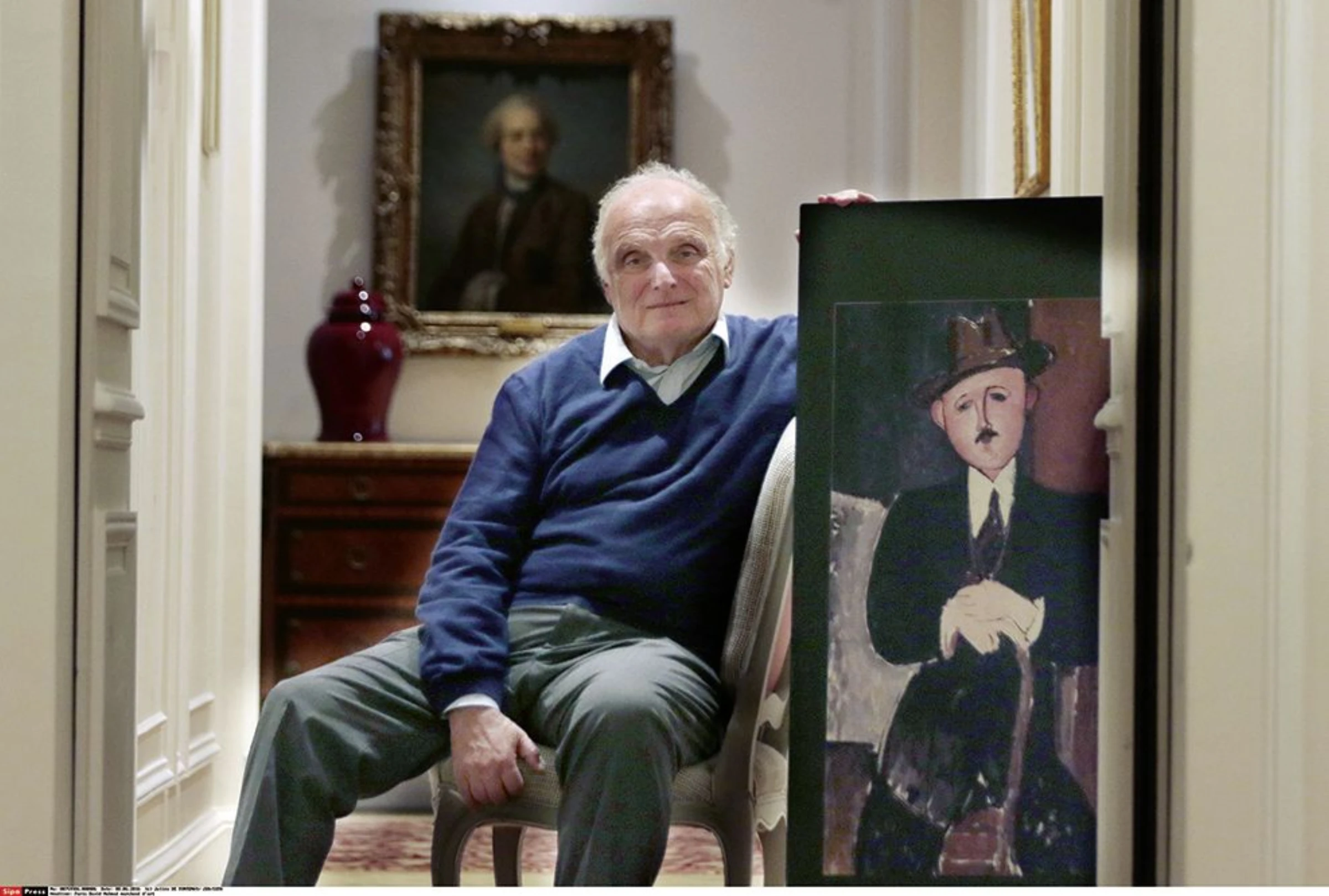
Court Orders Return of Disputed Modigliani, Resetting the Burden in Restitution Litigation
A New York ruling ordering the return of a Modigliani tied to wartime seizure strengthens claimant leverage in long-running restitution cases built around provenance gaps and postwar title disputes.
A New York court has ordered dealer David Nahmad to return Amedeo Modigliani’s Seated Man With a Cane (1918), concluding a dispute that has run for more than a decade and reopening hard questions about title, due diligence, and postwar market structure. The case centers on the claim of Philippe Maestracci, heir to dealer Oscar Stettiner, who fled Paris before Nazi occupation and lost control of his collection. The painting later re-entered the market through transactions that, the court found, did not extinguish Stettiner’s superior claim.
For the market, the significance goes beyond one object. Restitution litigation typically turns on documentation asymmetry: heirs must reconstruct interrupted ownership chains while current possessors argue uncertainty, distance in time, and transaction regularity. Here, the court emphasized that prior judicial findings and historical records outweighed speculative alternative ownership narratives. That shifts practical leverage toward claimants in similar cases where war-era dispossession is clear and subsequent provenance includes unexplained gaps.
The painting’s modern market journey is well known. It was sold at Christie’s in 1996 and later appeared for sale again in 2008 at Sotheby’s, where it did not sell. The claimant side in the modern phase has been supported by restitution specialists at Mondex. What is newly clarified is judicial tolerance for ambiguity in this category of property claims. The decision indicates that where documentary records establish pre-seizure title and no valid voluntary relinquishment is shown, the burden on present holders is heavier than many market participants have assumed.
Dealers and collectors often describe Nazi-era restitution as a moral issue that sits adjacent to ordinary commercial risk. In practice it is a core legal risk, and one with long tail exposure. A painting can remain in private storage for decades and still be vulnerable if archival evidence matures, heirs organize transnational counsel, or litigation venues become more receptive to historical claims. Insurers, lenders, and private-sale intermediaries are already pricing that uncertainty into high-value transactions with contested wartime intervals.
Institutions should read this outcome as a compliance signal. Museum boards, acquisition committees, and private foundations that still treat older provenance research as a one-time pre-acquisition checkbox are out of step with current legal reality. Continuous provenance review, especially for works that moved through occupied Europe in the late 1930s and 1940s, is now baseline governance. The strongest programs maintain living files, commission independent archival checks, and coordinate with specialist bodies before exhibition loans or collateralization.
The ruling also narrows a common rhetorical fallback in restitution disputes: the idea that elapsed time itself can cleanse title disputes in culturally significant works. Courts are increasingly willing to parse specific historical records rather than defer to market custom. That matters in an era when databases, digitized archives, and claim networks make historical reconstruction more feasible than it was twenty years ago. The market’s informational floor has risen, and legal expectations have risen with it.
For now, the decision reinforces a principle that many actors acknowledged publicly but often resisted operationally: provenance is not just scholarship, it is title architecture. Works with unresolved wartime intervals carry legal fragility no matter how many times they are traded. The Modigliani case demonstrates that fragility can surface long after acquisition, and at values far above initial purchase prices, with consequences that reach well beyond one owner.