Misan Harriman Turns Protest Photography Into a Permanent Civic Space at Hope 93
Misan Harriman’s The Purpose of Light returns to London as a permanent installation, expanding the role of small private galleries in shaping political photography discourse.
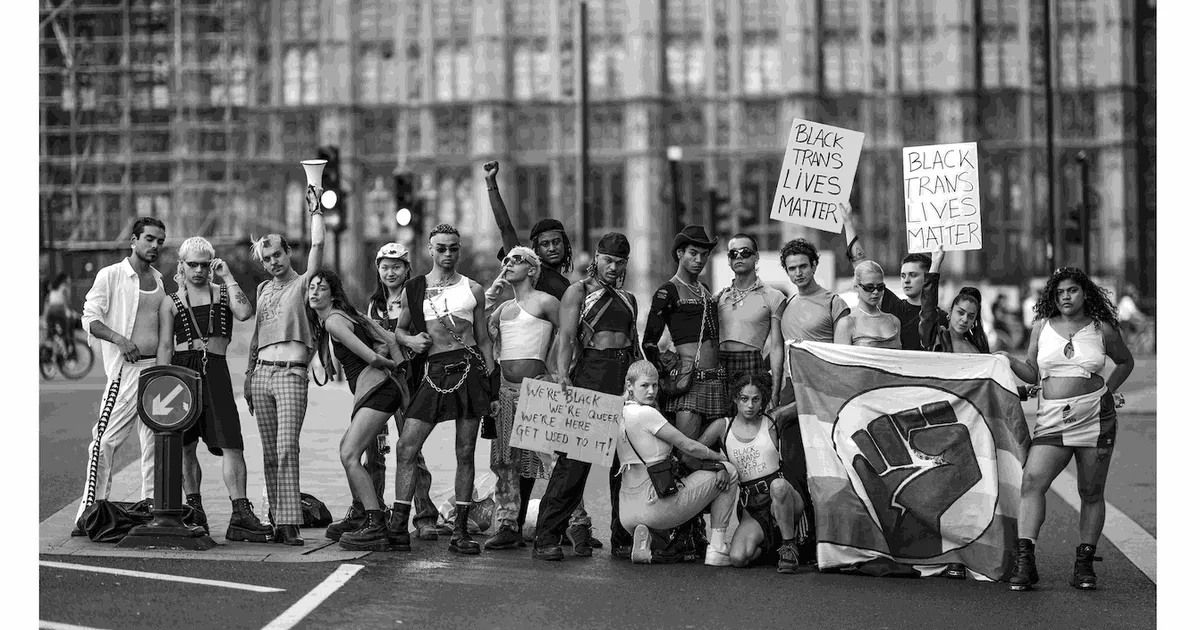
In London, photographer and filmmaker Misan Harriman has converted a successful temporary show into a permanent installation. The Purpose of Light, now fixed at Hope 93, assembles more than one hundred photographs drawn from seven years of protest documentation across the UK, the US, and South Africa. The move matters because permanence changes the work’s function. What began as an exhibition cycle now operates as a standing civic archive inside a commercial gallery framework.
Harriman is widely known for high profile editorial commissions, yet this body of work leans toward witness over celebrity. The images cover demonstrations connected to Black Lives Matter, Gaza, Congo, and other movements, with a visual approach that combines polished tonal control and street-level urgency. In practical terms, he uses techniques associated with magazine portraiture, natural light discipline, rapid compositional adaptation, and applies them to volatile public space. The result is not raw reportage and not studio formalism, but a hybrid language that is increasingly central in contemporary documentary photography.
The decision to make the installation permanent, backed by collectors who placed owned works in long term display, creates a notable institutional workaround. Smaller galleries rarely hold documentary projects in fixed public form unless supported by museum partnerships. Here, a private structure has produced continuity through collector alignment rather than public subsidy. For artists working with social movements, that model offers a potential path between short exhibition windows and full institutional acquisition.
Hope 93 founder Aki Abiola has framed the gallery as a space for artists historically underrepresented in dominant circuits. In that context, The Purpose of Light functions as both program and proposition, protest photography can be treated as sustained cultural memory rather than episodic response. The curation, described as dense and immersive, pushes viewers into accumulation rather than isolated image consumption, which mirrors how political pressure builds in public life, not in single moments but through repetition and return.
Harriman’s own framing is explicit. He has said the project is less about endorsing one position than about recording collective acts of refusal and solidarity during a period of social rupture. That distinction is important for curators and collectors evaluating politically charged work. The question is not only what the images depict, but what kind of civic time they preserve, and how the exhibition architecture lets viewers move through disagreement without flattening it into slogan.
There is also a broader governance angle. Harriman currently serves as chair of the Southbank Centre, so his gallery project lands in conversation with one of the UK’s flagship cultural institutions. This overlap does not make the work institutional by default, but it does place independent programming inside a wider policy conversation about artistic risk, public trust, and the role of cultural leadership at a time of backlash against diversity programs and heightened geopolitical polarization.
For collectors, the installation offers a practical case study in how social documentary work is entering long-horizon value systems. The market has historically rewarded singular iconic frames, while institutions prioritize coherent bodies of work. Harriman’s project sits between those poles, individual images can circulate, but the curatorial argument depends on scale, sequence, and context. Acquiring the work therefore involves not just image selection, but commitments around stewardship, display, and interpretive framing.
For London’s exhibition ecology, the permanence of The Purpose of Light is a reminder that consequential photography programming does not only flow from major museums. It can also be built through agile galleries willing to commit space, narrative continuity, and operational patience. In a city saturated with short-run shows, that may be the most important decision here, choosing duration when speed would have been easier.