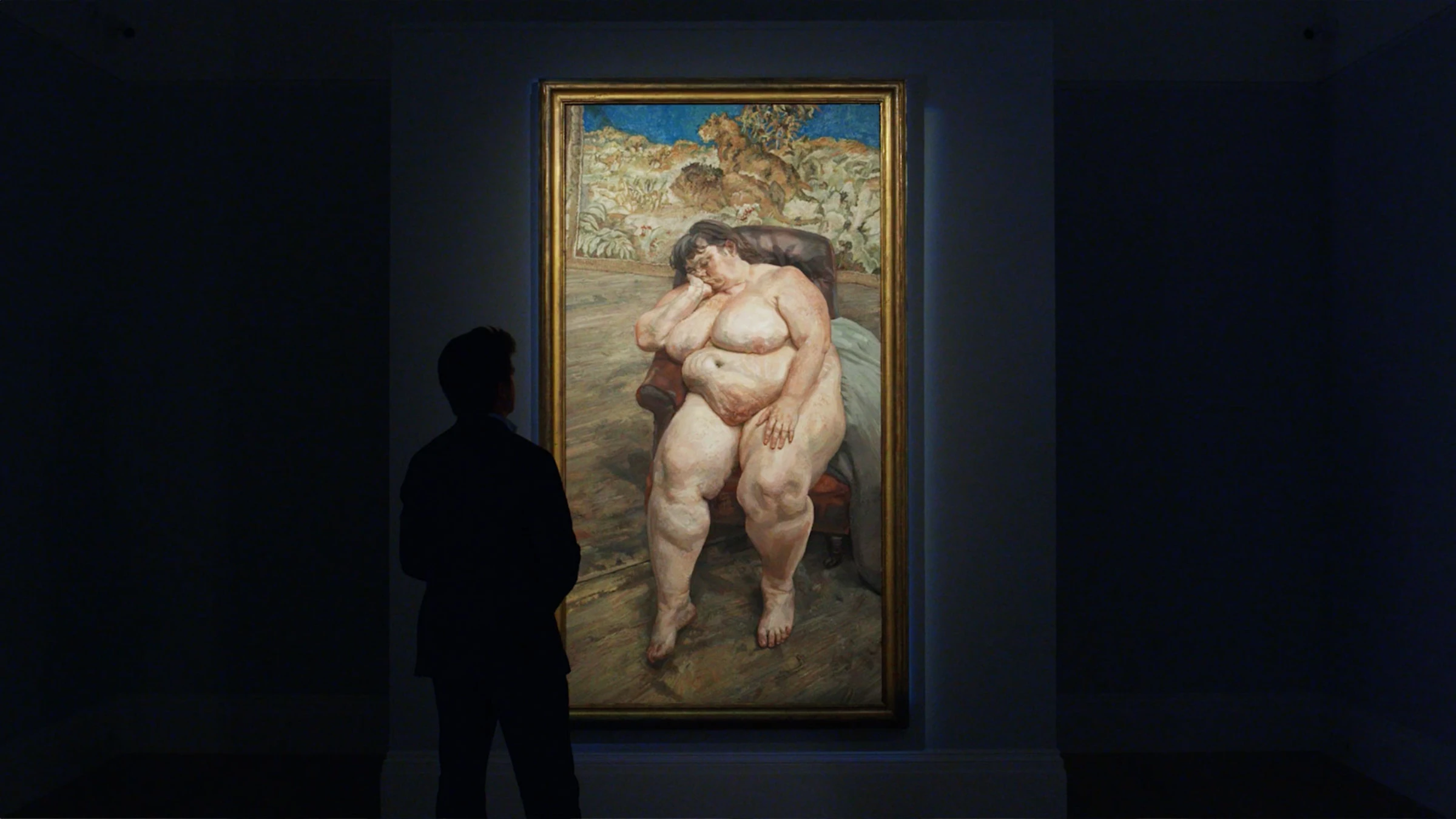
Why Lucian Freud’s Sleeping by the Lion Carpet Matters More Than Another Trophy Lot
Sotheby’s is bringing Lucian Freud’s Sleeping by the Lion Carpet to London with a £25m-£35m estimate, but the real story is how rarity, portraiture, and auction theater reinforce each other.
Sotheby's is not simply selling a famous nude but staging a lesson in scarcity
When Sotheby's adds Lucian Freud's Sleeping by the Lion Carpet to the Lewis Collection sales in London, it is doing more than dropping one more blue chip object into the June calendar. The house is reminding the market how effectively Freud's best portraits convert rarity into authority. The picture carries a £25 million to £35 million estimate, which is large even by the artist's standards, yet the figure feels almost secondary to the symbolic work the lot performs. Here is a painting from the mid 1990s, a period when Freud had already settled into the severe, slow, flesh building mode that turned his portraits into tests of endurance for artist, sitter, and viewer alike. Here too is Sue Tilley, the sitter whose body became inseparable from Freud's late reputation in both museums and auction rooms. Supply is tiny, competition is global, and the story arrives preloaded with an art historical script the market knows how to monetize.
The immediate headline is simple. A major Freud from the celebrated series of portraits of Tilley is coming to auction for the first time, and it is expected to push the total value of the Lewis Collection presentation at Sotheby's even higher. But the reason this matters is not only price. It is that works like this one help explain how the contemporary market keeps producing inevitability around certain artists. The mechanisms are familiar: a recognizable sitter, strong museum exhibition history, an owner with the aura of a serious collector, and a narrative of rarity that tells buyers they are not purchasing a painting so much as stepping into a narrow lane of institutional legitimacy.
Sue Tilley is central because Freud used her to reinvent the terms of monumentality
Freud's portraits of Sue Tilley remain shocking not because they offer scandal, but because they refuse the forms of flattering grandeur that portraiture historically used to reward patrons and rank. Tilley was not an aristocrat, collector, or dynastic benefactor. She was a benefits supervisor introduced to Freud by Leigh Bowery, and the series that followed did not convert her into an idealized symbol. Instead Freud let weight, skin, fatigue, posture, and sheer physical presence dominate the canvas. In the mid 1990s he made large paintings in which the human body was not corrected or redeemed by elegance. It was built, insisted on, and held in the room with an almost geological patience. That is one reason the works continue to matter beyond their auction performance. They forced portraiture to confront the body as lived fact rather than social costume.
Sotheby's own language about the work is revealing. Its video essay describes the painting as a structure in which flesh begins to feel architectural, an apt way to describe Freud's late handling of mass and pressure. That emphasis matters because it nudges the lot away from gossip about famous nudes and back toward painting. The best Freud portraits do not merely represent bodies. They reorganize space around bodies. In Sotheby's account of the work, the riot of the lion carpet, the tilt of the floor, and the dense accumulation of blue, grey, pink, and ochre all contribute to a picture that feels unstable and exact at once. The result is not sensuous in the easy way people often mean when they discuss Freud. It is stubborn, even punitive, and all the stronger for it.
The Tilley paintings also expose the market's dependence on recognisable internal histories. Collectors like stories with numbered chapters, and Freud gives them one here. Benefits Supervisor Sleeping broke a record in 2008. Benefits Supervisor Resting reset expectations in 2015. Now Sleeping by the Lion Carpet arrives as the next monumental installment, allowing the market to compare, sequence, and rank a small family of related works. That narrative continuity is part of the value. Buyers are not only bidding on one canvas. They are bidding on proximity to a series already canonized by museums, critics, and prior auction headlines.
The Joe Lewis provenance adds theater, but the more important fact is timing
This painting enters the room through the collection of Joe Lewis, whose holdings of figurative painting have been aggressively mythologized in the run up to the June sales. Provenance always has a double function. It reassures buyers that the work has passed through hands associated with money and conviction, and it gives the auction house a way to narrate private taste as public event. Here, though, the more interesting point is historical timing. Lewis began buying Freud in the 1990s, before the artist's auction market reached its present level of ritualized intensity. That means the sale does not simply dramatize wealth. It dramatizes an older pattern of accumulation in which a collector identified the force of Freud's market before it calcified into orthodoxy.
That timing now feeds the estimate. Auction houses are adept at presenting early collector conviction as evidence of long view connoisseurship. Sometimes that is true. Sometimes it is retrospective myth making. Usually it is both. Either way, by the time a work like this resurfaces, the market has already naturalized the idea that it belongs in the highest tier. Readers of our guide to reading provenance claims in real time will recognize the pattern. The estimate does not just measure expected price. It performs confidence, inviting buyers to treat the auction house's valuation as the latest chapter in a long consensus rather than as an argument designed to bring bidders into the room.
There is another timing issue too. London needs works like this right now. High end evening sales depend on anchor lots that can carry symbolic weight even if bidding at the very top becomes more selective. A market worried about macroeconomics, geopolitics, and uneven liquidity still loves clarity. Freud offers clarity. He is dead, scarce, museum tested, and legible across the Atlantic, Europe, and Asia. If a contemporary art season starts to feel noisy, a big Freud portrait arrives as a stabilizer.
The painting's public life in museums is part of why it can now function as a market event
One reason this work carries unusual force is that it has already done its institutional labor. According to Artnet's report, the portrait has appeared in every major museum survey of Freud since it was made, including the National Gallery's 2022 exhibition in London. That history matters because it means the auction house is not asking buyers to imagine future canonization. Canonization is already substantially in place. Museums have placed the work inside the artist's narrative. Critics have explained its importance. The market now harvests that prior labor.
This is one of the least discussed truths of top end auction culture. Museums and scholarship rarely set prices directly, but they create the conditions under which certain prices feel justified, even inevitable. Once a picture has circulated through survey exhibitions, catalogue essays, and documentary material, it becomes harder to see it merely as a private commodity. It begins to carry the glow of a public object temporarily passing through private exchange. That glow is powerful. It lets buyers feel that acquisition is also a form of custodianship.
The irony is that Freud's work, so often discussed in relation to uncomfortable looking, now moves through one of the smoothest prestige circuits available to modern painting. Viewers who stand before the work in the pre sale exhibition will still encounter a difficult picture. They will also encounter a sales script polished to make difficulty look inevitable, prestigious, and safely collectible. Auction houses are now very good at that conversion.
What happens in June will say something about appetite, but not everything about value
It would be easy to treat the June result as a referendum on the strength of the Freud market. It will not be. One sale never settles an artist's standing, and the price realized will depend on currency, competition from other lots, guarantee structures, and bidder temperament on the night. But the lot does offer a useful snapshot of what the market still rewards most decisively: pictures that sit at the overlap of institutional endorsement, identifiable series, and scarcity narratives strong enough to flatten buyer hesitation.
If the work exceeds expectations, the lesson will not simply be that wealthy buyers still want Freud. It will be that the market remains hungry for paintings that feel both singular and already certified. If it lands closer to estimate, that will not diminish the painting either. It may simply show that even canonical lots now face a more disciplined buying environment. The deeper point is that Sleeping by the Lion Carpet does not need a record to matter. It matters because it reveals how portraiture, scholarship, provenance, and auction strategy now reinforce one another at the top end of the trade.
There is also a more basic artistic truth that should survive the sales pitch. Freud painted slowly enough, and with enough ruthless concentration, that the best of his large portraits still exceed the stories built around them. You can say Sue Tilley, late Freud, Joe Lewis, June London, and £35 million and still not exhaust what is strange about the picture itself. The blue carpet does sing, as Freud reportedly said, but it also destabilizes the whole field, trapping the sleeping body in a room that feels both intimate and theatrical. That tension is why the painting keeps returning to view. Not because the market needs another trophy, but because the work still resists being reduced to one.
For buyers, the real wager is not just whether Freud remains bankable. It is whether paintings of this severity can continue to command collective attention in a market increasingly crowded with spectacle. My guess is yes. Spectacle fades fast. A picture that can hold a room through its own pressure and intelligence tends to outlast the scripts built around it. June will provide a number. The stronger evidence will be whether viewers leave the sale remembering the estimate or the painting. With Freud at his best, those are not always the same thing.