How to See Frida Kahlo and Diego Rivera in Mexico City
Museo Dolores Olmedo’s reopening reshapes the smartest Frida and Rivera itinerary in Mexico City. Build a visit around context, not checklist tourism
Start With the Reopened Dolores Olmedo, Not the Obvious Instagram Queue
If you want to understand Frida Kahlo and Diego Rivera in Mexico City in 2026, start in Xochimilco at the reopened Museo Dolores Olmedo, not at the most obvious tourist bottleneck. The museum’s return after six years of closure changes the map because it restores public access to the deepest concentration of Rivera and Kahlo works held together under one institutional vision. As The Art Newspaper reported, the museum has reopened with 98 Riveras, 26 Kahlos and newly accessible private rooms that make the collector Dolores Olmedo impossible to ignore. That is exactly why it should be first. Before you go chasing icons, you need the context of how these artists were collected, staged and turned into heritage.
The house-museum setting matters. La Noria in Xochimilco gives you more than wall labels and masterpieces. It places the work inside a collector’s world of gardens, domestic theater, pre-Hispanic objects and social aspiration. Rivera and Kahlo are not presented as floating celebrity images but as part of a network of friendship, patronage and institutional power. The reopening also makes the museum an active political site, because its collection nearly left the neighborhood during the relocation battles of the last several years. Starting here means beginning with the question of where cultural memory belongs, not merely which painting is most famous.
Plan to move slowly. If you treat Dolores Olmedo as a quick side trip, you will miss what makes it essential: the way Rivera broadens beyond muralist shorthand, the way Kahlo’s paintings recover weight when stripped of merchandise aura, and the way Dolores Olmedo herself emerges as a protagonist rather than a name on a donor plaque. Give yourself at least half a day. Read the rooms as an argument about inheritance, not just an inventory.
Use Museo Anahuacalli to Understand Rivera’s Civilizational Imagination
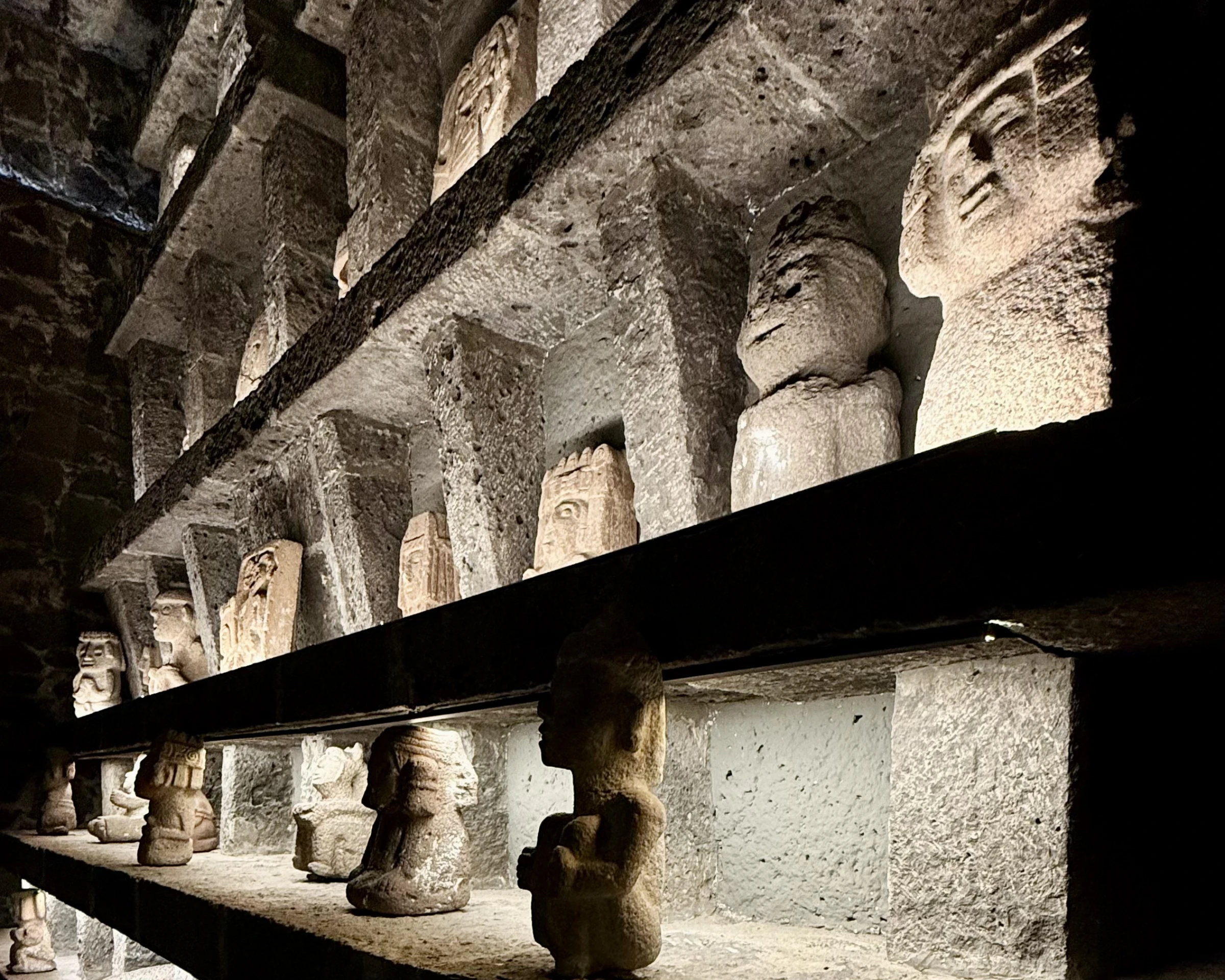
After Xochimilco, go to Museo Anahuacalli. If Dolores Olmedo shows the collector network around Rivera, Anahuacalli shows the scale of his historical appetite. Rivera conceived the museum as a place to return pre-Hispanic art and memory to the Mexican public, and the institution still frames its collection through that civic claim. The building itself is not background. Its volcanic-stone mass, temple-like geometries and relationship to the Pedregal landscape tell you immediately that Rivera was imagining culture on architectural and cosmological terms, not simply as a sequence of portable objects.
This is where many rushed visitors make a mistake. They visit Casa Azul, leave with a few intimate details and assume they have seen the pair. But Rivera’s worldview was materially expansive, archaeological and infrastructural. Anahuacalli helps explain why his murals look the way they do, why indigeneity mattered to his self-construction, and how collecting became part of his political theater. The museum also corrects the lazy assumption that Rivera exists only as Frida’s counterpart in biographical storytelling.
Read the collection critically, not reverently. Rivera’s engagement with pre-Hispanic forms was generative and extractive at once, shaped by nation-building ambitions and modernist appropriation. That tension is part of the point. A serious visit does not require you to resolve it. It requires you to notice how Mexico’s cultural institutions have preserved, framed and contested that legacy over time.
Approach Casa Azul as a Biography Machine, Then Resist It
You should still go to Museo Frida Kahlo, but go with defenses up. Casa Azul remains one of the most emotionally charged artist houses in the world, and for good reason. The domestic spaces, objects, clothing and traces of illness can make Frida feel physically near in a way few museums manage. But the site is also vulnerable to the flattening pressure of celebrity pilgrimage. Visitors arrive with a ready-made mythology and often leave with it intact.
To avoid that trap, use Casa Azul to study framing rather than simply consume intimacy. Ask what kinds of objects the museum uses to narrate Kahlo’s pain, politics and self-fashioning. Notice what happens when personal artifacts are placed beside paintings. Pay attention to how the institution balances scholarship, devotion and crowd management. If the house threatens to turn Kahlo into an endlessly reproducible symbol of resilience, push back by reconnecting the visit to the darker, sharper works you saw at Dolores Olmedo.
This is also where time of day matters. Early slots tend to reward close looking before the rooms fill. If you can only visit at peak hours, narrow your attention rather than trying to see everything. Pick a few rooms or works and study how the museum constructs their emotional force. Better a concentrated hour than a frantic checklist sprint through every doorway.
Add a Public-Museum Counterweight to the Artist Houses
To keep the trip from collapsing into private mythologies, add at least one public museum stop. The broad INBAL network is a useful frame because it reminds you that Mexican modernism lives inside a state cultural infrastructure, not only in charismatic houses. Depending on current programming and access, a stop at major INBAL-linked venues such as the Palacio de Bellas Artes or Museo de Arte Moderno can reset your eye after the intimacy of house museums and collector estates. These spaces place Rivera, Kahlo and their contemporaries inside larger debates about public art, national identity and exhibition history.
This counterweight matters because both Rivera and Kahlo are vulnerable to overpersonalization. Rivera becomes “the muralist giant,” Kahlo becomes “the suffering icon,” and the institutional conditions that made their afterlives possible disappear. Public museums restore some of that structure. They show how state patronage, education systems and canon formation shaped what counts as Mexican modern art in the first place.
They also help you read scale. After intimate encounters in Coyoacán and Xochimilco, a large public museum throws different questions at the work: how it performs at distance, how it participates in national narrative, and how institutions balance reverence with reinterpretation. If you have recently read artworld.today’s piece on Crystal Bridges’ expansion, the contrast is useful. Different national contexts, same underlying problem: how museums package civic ambition without draining art of difficulty.
Build the Itinerary Around Questions, Not Around Fame
The best Frida-Rivera itinerary is not “most famous works first.” It is a sequence of questions. Start with Dolores Olmedo and ask how collecting shapes legacy. Continue to Anahuacalli and ask how Rivera turned architecture and pre-Hispanic heritage into a modern political language. Go to Casa Azul and ask how a museum manufactures intimacy around an artist whose image has become globally marketable. End in a broader public museum setting and ask how the state frames these artists for collective memory.
That question-driven structure will improve practical choices too. It tells you where to spend energy, where to book ahead and where to slow down. It also helps you absorb contradiction instead of smoothing it away. Rivera was a public artist and a self-mythologizer. Kahlo was deeply singular and massively commodified. Dolores Olmedo preserved indispensable works while embedding them in her own social world. None of that contradiction is a problem to be cleaned up. It is the substance of the trip.
Logistically, split the itinerary across at least two days if possible. Pair Xochimilco and Anahuacalli if you want a southern route grounded in site and collection. Give Casa Azul its own time block because crowd volume changes the experience dramatically. Keep one additional museum slot flexible in case a temporary exhibition or conservation closure changes priorities. A rushed all-in-one day produces fatigue exactly when careful looking is most needed.
What a Serious Visit Reveals in 2026
The reopening of Museo Dolores Olmedo makes 2026 an unusually good moment to revisit how Mexico City presents Kahlo and Rivera. The city now offers a fuller circuit in which collector legacy, artist biography, pre-Hispanic imagination and public institutional framing can be read together. That is far more interesting than the version sold by generic travel guides, which often reduce the experience to Frida fandom plus one mural stop.
A serious visit shows something harder and better. It shows that both artists survive through institutions that are themselves contested: house museums vulnerable to tourism pressure, collector museums shaped by governance fights, and public museums tasked with carrying national stories that never stay settled. If you build your route with that in mind, Mexico City gives you more than masterpieces. It gives you a crash course in how art history gets housed, fought over and made public.
One final practical rule: leave room for return rather than pretending one route can settle everything. Rivera and Kahlo reward second looks because the institutions around them are doing different kinds of historical work. A collector museum reveals one truth, an artist house another, and a public museum a third. If you feel the story refusing to stay tidy, that means the itinerary is working. Mexico City is giving you the artists in motion through politics, architecture, fandom and state memory rather than as fixed legends.
That is the right way to leave the city too. Not with the feeling that you have completed a brand, but with the sharper sense that Kahlo and Rivera still produce arguments about ownership, identity, nation and display. Any itinerary that preserves those arguments has done its job.